
Combat Simulator
Introduction
This Python script simulates turn-based combat between a player and an enemy using configurable stat inputs and scaling formulas. Combat outcomes are determined through weighted random rolls for accuracy and damage, and a Monte Carlo approach runs thousands of simulated encounters to model realistic combat variability across different level ranges and progression states.
By aggregating results across simulations, the tool analyzes win rates, average damage output, time-to-defeat, and overall outcome distributions. Rather than relying solely on isolated playtests, this tool provides a data-informed view of how stat growth and scaling adjustments shape difficulty curves and player progression. It allows me to identify balance breakpoints, refine tuning parameters, and intentionally design combat experiences that feel challenging, fair, and rewarding before implementing them in-engine.
Enemy Stats
The enemy stats are calculated using a Power Point system. This system provides a structured framework for scaling enemy difficulty by assigning each enemy a total power budget that defines its overall strength. Rather than arbitrarily adjusting stats, the Power Point system ensures progression feels intentional, fair, and smoothly paced. The Weights system then determines how that power is distributed across their attributes: health, damage, and accuracy. This tool has a few predefined presets that allow enemies to fulfill distinct combat roles like high-damage threats or durable tanks. Together, these systems create meaningful encounter variety while maintaining balance, supporting both strategic depth and a consistent player experience throughout progression.
| Archatype | Health Weight | Damage Weight | Accuracy Weight |
|---|---|---|---|
| Balanced | 0.33 | 0.33 | 0.34 |
| Tank | 0.55 | 0.30 | 0.15 |
| Bruiser | 0.45 | 0.40 | 0.15 |
| Sniper | 0.25 | 0.35 | 0.40 |
| Glass Cannon | 0.20 | 0.50 | 0.30 |
Play Stats
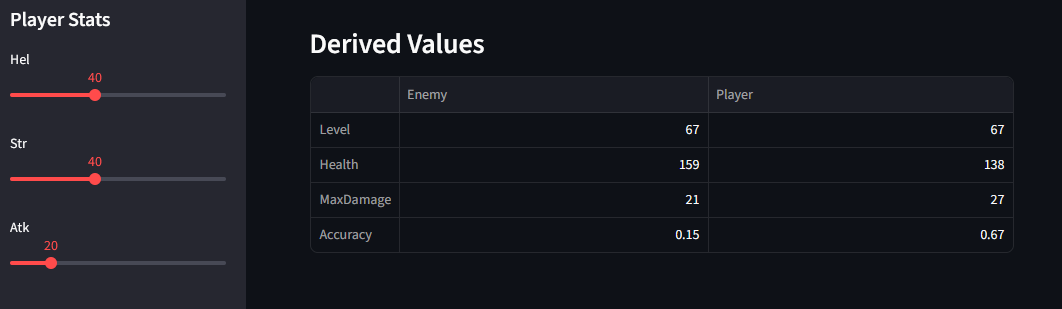
Player stats are configured independently to define the character’s combat profile. A derived combat level, calculated from the total allocation of combat stat points, is used as a balancing reference when comparing the player to similarly leveled enemies. Each stat feeds into a separate scaling function that determines its contribution to the player’s final combat values (health, damage, and accuracy). These functions are fully tunable, allowing progression to feel impactful while maintaining controlled overall power growth across the full stat range.
Accuracy and Damage
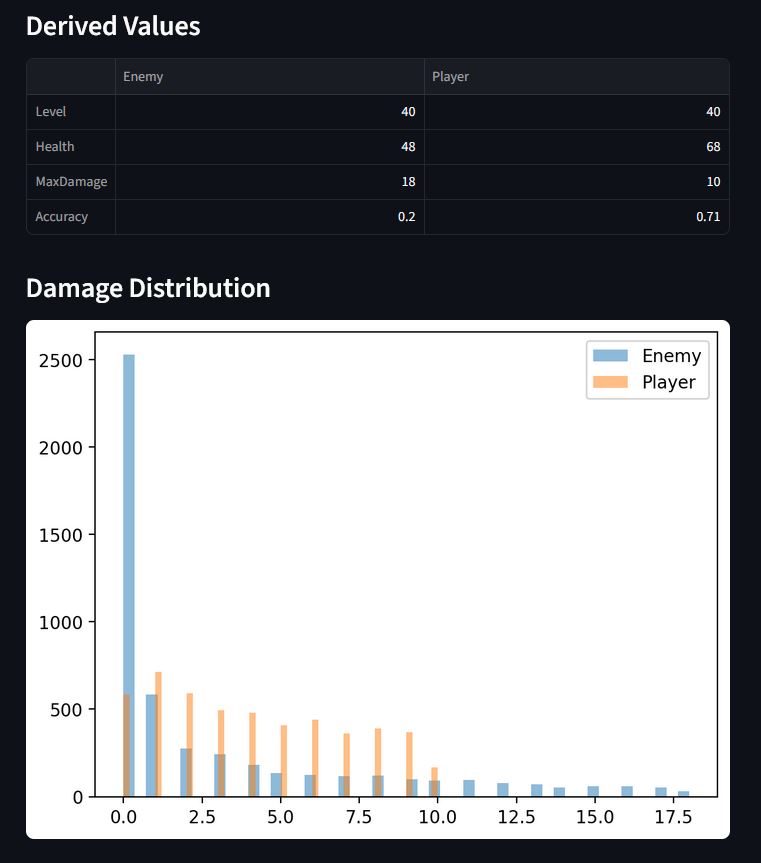
Accuracy in this system does not determine whether an attack lands or misses; instead, it governs how consistently a character deals damage relative to their maximum potential. Each attack always connects, but the character’s accuracy rating influences the amount of damage dealt. Lower accuracy results in greater variance, causing attacks to frequently deal reduced damage compared to the character’s maximum damage value. As accuracy increases, damage outcomes cluster more tightly toward the upper end of the damage range, meaning a larger percentage of attacks approach or reach maximum damage. At very high accuracy levels, damage becomes highly consistent and reliably close to the character’s theoretical maximum. This approach preserves the impact of the Accuracy stat while avoiding binary hit-or-miss outcomes, making it a measure of damage reliability rather than hit chance.
Combat Simulation
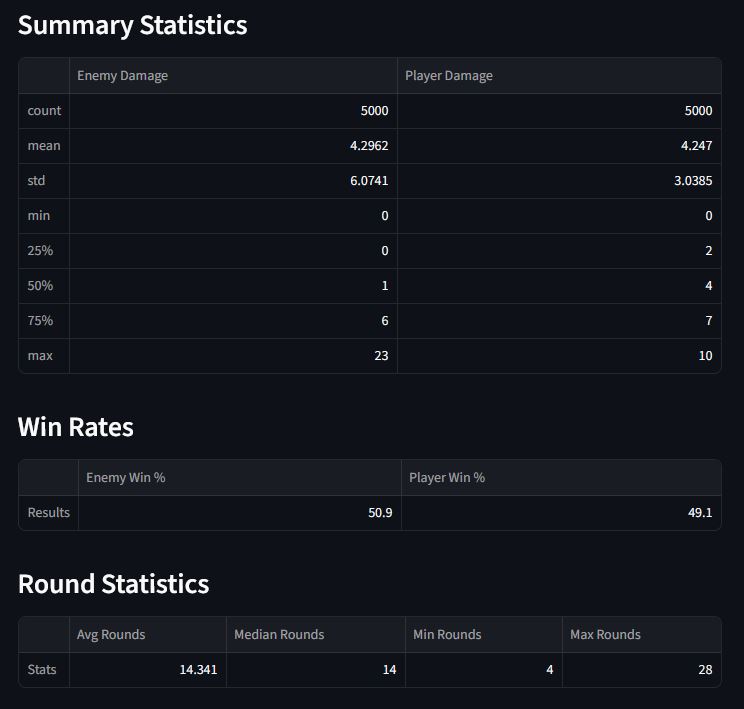
The combat simulation system models repeated one-on-one encounters between a player and an enemy using their derived combat statistics, including health, maximum damage, and accuracy-based damage consistency. Each simulation runs turn by turn until one combatant is defeated, with damage outcomes influenced by a probabilistic accuracy model that adjusts how closely attacks approach maximum damage. By executing a large number of simulated battles, the tool generates statistically meaningful results such as win rate, average fight duration, damage distribution, and overall outcome variance. This data-driven approach allows for systematic balance testing, making it possible to evaluate build viability, measure the impact of stat scaling adjustments, and identify dominant or underperforming configurations within the combat system.
Conclusion
This tool demonstrates my approach to combat system design as a balance between mathematical modeling and player experience. By combining tunable stat-scaling functions with large-scale combat simulations, I am able to evaluate balance decisions through measurable outcomes rather than intuition alone. The system provides a controlled environment for testing progression curves, stat interactions, and build diversity before implementation in-engine. Using this framework, I can rapidly iterate on combat mechanics, identify balance issues early, and ensure that progression remains meaningful without allowing power to scale uncontrollably. Ultimately, the tool serves as both a balancing instrument and a design laboratory, enabling the creation of combat systems that are fair, expressive, and strategically deep.